
When planning an ADU, most decisions focus on layout, cost, or finishes. Framing method rarely gets the same attention, but it has a direct impact on schedule, coordination, and how smoothly the project moves once construction begins.
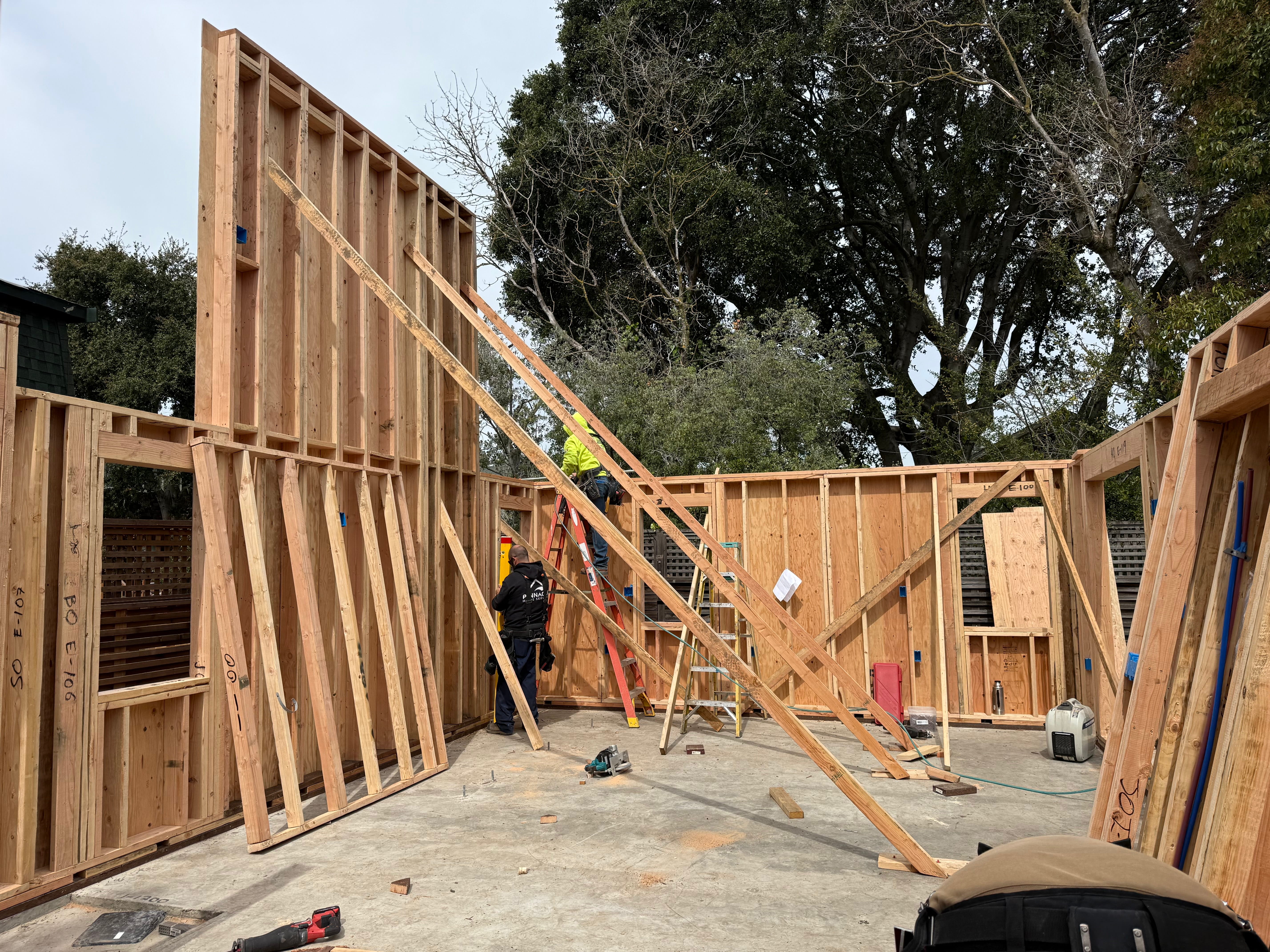
Panelized framing offers a different approach. Instead of building every wall in the field, the structural shell is fabricated in a controlled environment and delivered to site for installation.
It is not a shortcut. It is a more controlled way to execute one of the most complex phases of the build.
Traditional framing solves problems in the field; Panelization moves that work earlier
In a conventional stick-framed ADU, the framing crew lays out and assembles the structure on site. That includes window openings, wall alignment, and coordination with structural and MEP requirements as they are encountered.
This approach works, but it is inherently reactive. Site conditions, crew decisions, and sequencing all influence how the framing comes together.
Panelized construction shifts that process earlier.
During the shop drawing phase, the framing system is coordinated in detail between the architect, structural engineer, and fabricator. This includes layout of wall panels, structural members, and key interfaces with systems like plumbing lines and vent stacks. This process, often referred to as clash coordination, allows conflicts to be identified and resolved before materials are fabricated.
The result is not a different building, but a different sequence of decision-making. More is resolved on paper, and less is left to interpretation in the field.

Panelized ADU framing is not a shortcut. It is a more controlled way to execute one of the most complex phases of the build.
The issues panelization avoids are common, not catastrophic, but they add time and variability
Field framing does not typically fail, but it does involve a series of small adjustments that can compound over time.
For example, it is common to see window openings framed slightly off in size or placement, requiring adjustment during installation or resulting in minor alignment inconsistencies. In tighter areas like kitchens and bathrooms, plumbing lines can compete with framing members, leading to in-field modifications. Structural elements may also need to be shifted once other trades begin work.
These are normal parts of construction, and experienced general contractors plan for them.
Panelization does not eliminate these conditions entirely, but it reduces how often they occur by resolving more of the coordination up front. Instead of adjusting framing in response to conflicts, many of those conflicts are addressed during clash coordination before fabrication begins.
Panelized framing overlaps fabrication with site work, shortening the path to dry-in by several weeks
One of the more visible benefits of panelization is schedule. Because the structural shell is fabricated off site, that work can happen in parallel with foundation construction rather than after it.
A typical sequence looks like this:
Weeks 1–2: Factory fabrication (concurrent with foundation work)
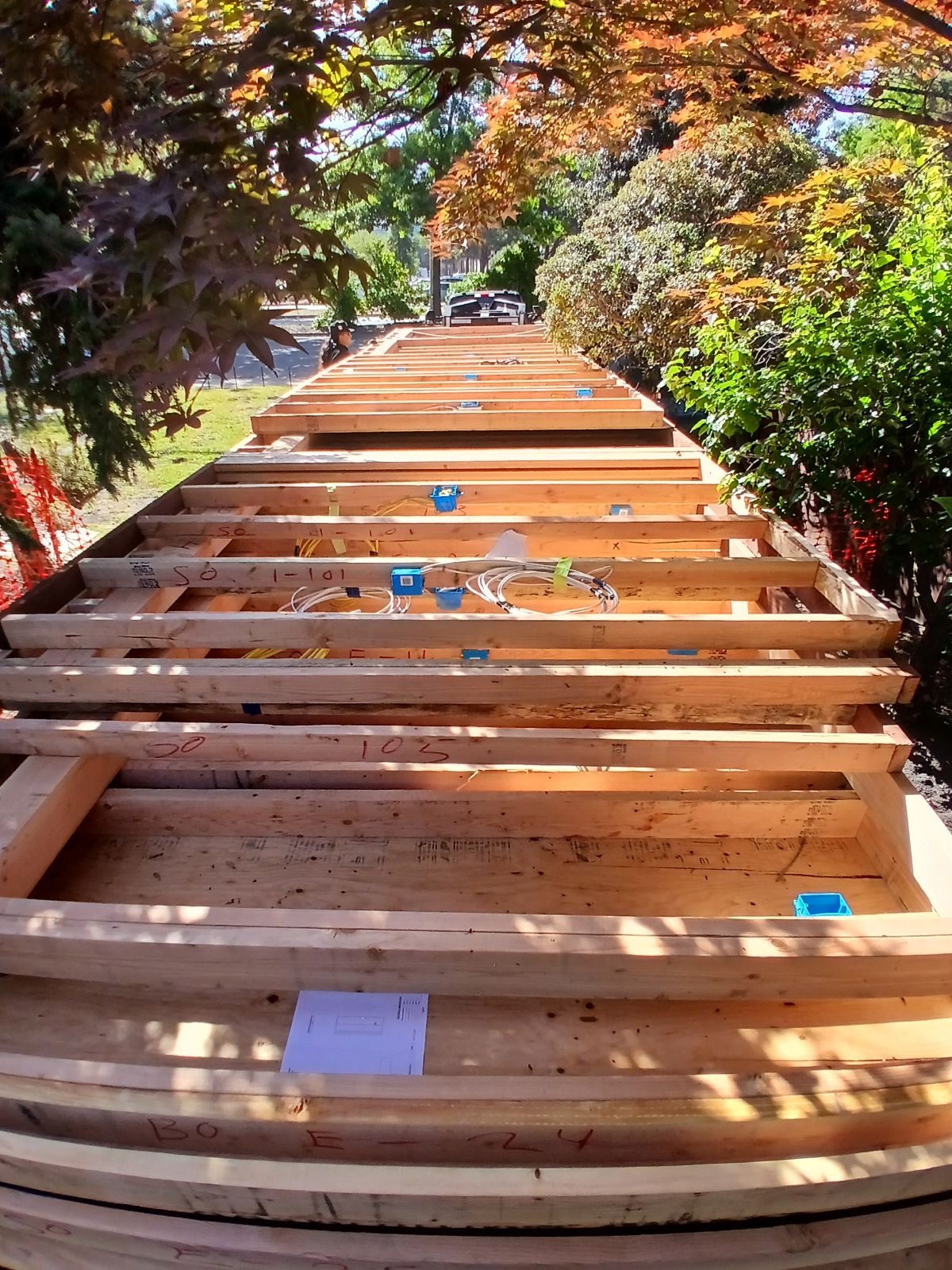
Wall panels are fabricated while the foundation is being prepared, poured, and cured. Key field measurements are confirmed before fabrication is finalized. Panels are labeled and sequenced for installation.
Week 3: Wall panel delivery and installation (2–3 days)
Panels are delivered, unloaded, and installed over a few days. The general contractor completes minor field adjustments where needed, though most coordination has already been resolved during shop drawings.
Week 4: Roof truss delivery and installation (1–2 days)
Roof trusses arrive shortly after wall installation and are typically set in one to two days, depending on site conditions.
Because fabrication overlaps with foundation work, and installation is more streamlined in the field, panelized framing typically shortens the dry-in timeline by several weeks. In many cases, the combined effect is on the order of a month, though actual savings will vary based on the project and general contractor.
Panel kits improve the structure without limiting how the ADU is finished
Panelized framing is sometimes confused with modular construction, but the two operate very differently.
With panel kits, only the structural shell is prefabricated. Everything else, including siding, roofing, windows, doors, and interior finishes, is completed on site using conventional methods.
This allows for the same level of finish quality as a custom build. It also makes it possible to align the ADU closely with the main home. Materials, proportions, and detailing can all be adjusted in the field rather than predetermined in a factory.
The benefit of panelization is in how the structure is delivered, not in restricting design choices.
Panel kits are most effective for ground-up, wood-framed ADUs with repeatable geometry, and less effective for complex or hybrid conditions
Panelization is not the right fit for every project.
It tends to work best for detached, ground-up ADUs that rely on conventional wood framing and relatively consistent geometry. In these cases, the efficiencies of fabrication and coordination are most impactful.
It is generally not a strong fit for conversions, attached ADUs that require complex tie-ins to an existing structure, or highly custom designs with irregular geometry. Projects that rely on steel framing, often driven by large glass openings or long-span interior spaces, also fall outside the typical panelized approach.
In these situations, field-built framing is usually more appropriate and more adaptable to changing conditions.
A panel kit replaces the framing phase, not the rest of the construction process
A panel kit is a framing package, not a complete building system.
It typically includes exterior and interior wall panels, engineered roof trusses, sheathing, and a full set of shop drawings and installation documentation.
It does not include foundations, windows, doors, mechanical systems, finishes, or site work. Those remain the responsibility of the general contractor and trades.
A useful way to think about it is that panelization replaces one phase of construction, framing, with a more controlled version of that same phase. The rest of the project proceeds as a conventional build.
A different way to manage coordination and risk in small-scale housing
For ADUs, where space is tight and systems are closely integrated, small coordination issues can have outsized impacts on schedule and cost.
Panelized framing addresses this by shifting more coordination into the design and documentation phase, where changes are easier to make and easier to control.
It does not change what you are building. It changes how predictably you can get there.
Next Steps
If you are evaluating different approaches for your ADU, framing method is worth considering alongside layout and budget.
Panelization is one way to reduce variability, compress early timelines, and bring more coordination into the front end of the project.
If you want to understand whether it is a fit for your project, we are happy to walk through the tradeoffs and show how it would apply to your specific site and design. Please reach out to us at hello@inspiredadus.com or book an appointment at https://www.inspiredadus.com/contact-us to learn more.
.svg)


