
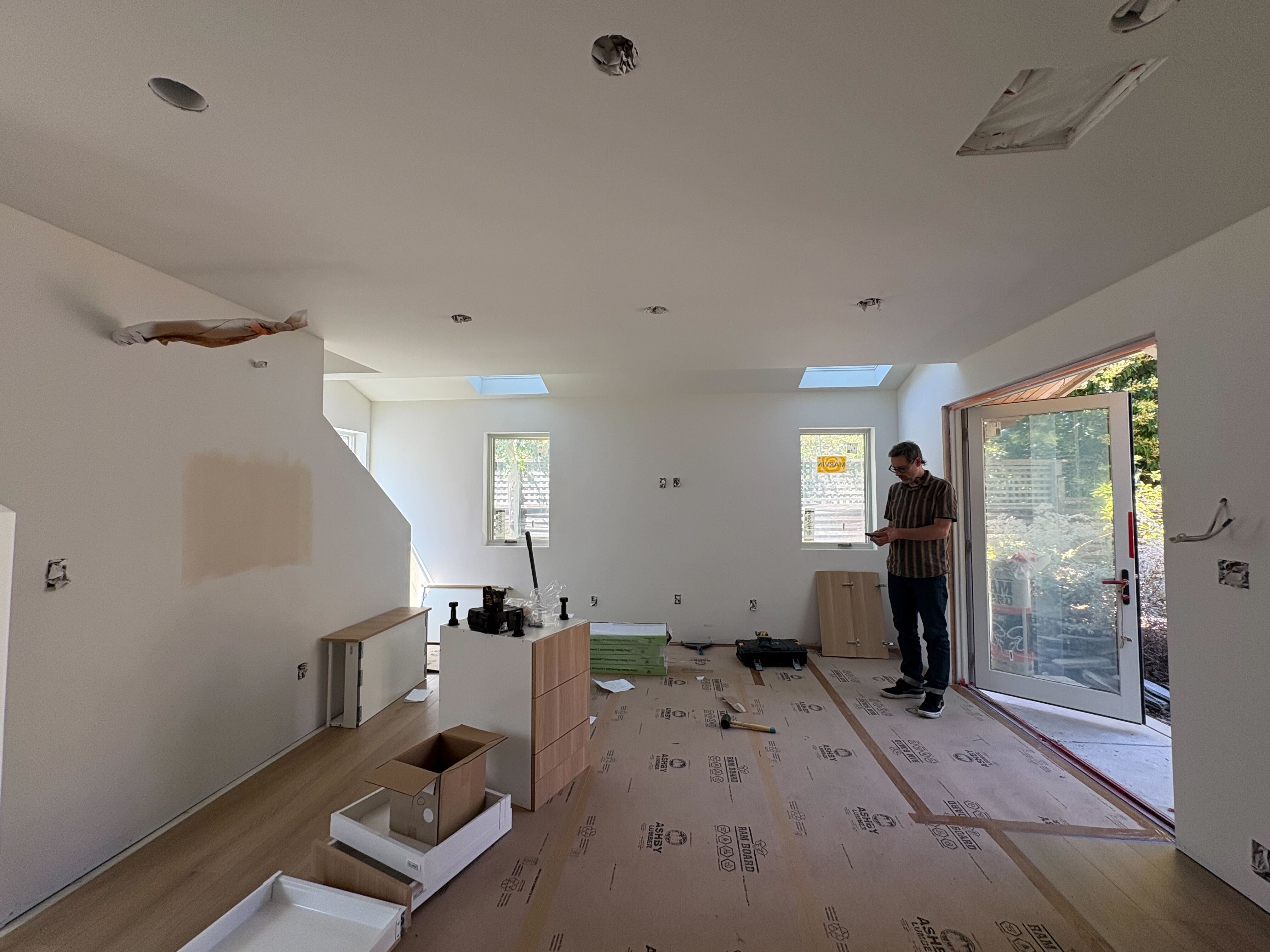
Moving from permit drawings to construction is where many of the most important decisions get tested in real conditions. Even with a well-developed set of drawings, questions, adjustments, and coordination needs will come up as the project is built.
At Inspired ADUs, we stay involved during construction to review key milestones, respond to field conditions, and help ensure the project is executed as intended.
Construction Administration is not full-time site supervision. It is targeted involvement at the moments where coordination matters most.
To support construction effectively, we typically budget a minimum of $2,000-5,000 for core Construction Administration activities. This is often on the order of ~1% of total construction cost.
This baseline is designed to cover the key points in the project where early verification and coordination can prevent rework, delays, or misalignment between drawings and field conditions. The exact level of involvement scales with project complexity, finish level, and the experience of the general contractor.
In projects built with general contractors from our preferred builder network, we often see fewer RFIs, less in-field adjustment, and a more predictable construction process overall. This typically translates to lower coordination effort during Construction Administration and a smoother path through key milestones.

Construction Administration is not full-time site supervision. It is targeted involvement at the moments where coordination matters most.
Pre-Construction Kickoff & Site Walk (1–2 hours + travel)
We meet with your general contractor for a working session that includes a page-turn of the permit set and a site walk. This is where we align on how the drawings translate into construction, clarify any open questions, and establish how coordination will happen during the build.
Foundation & Underground MEP Review (1–1.5 hours + travel)
We review foundation formwork and underground mechanical, electrical, and plumbing line placement prior to the concrete pour. At this stage, wall locations and utility stub-outs are being fixed in place, so confirming layout and positioning is critical.
Window & Door Submittal Review (3–5 hours)
We review manufacturer submittals against the architectural set, including sizing, operation, and detailing. Window openings and structural framing must align precisely, and catching discrepancies at this stage avoids delays, reordering, or reframing later.
Framing & MEP Rough-In Walkthrough (2–2.5 hours)
Once framing, blocking, and in-wall MEP systems are in place, we walk the project before insulation and drywall. This is the key moment to verify alignment of plumbing lines, lighting locations, and backing for cabinetry and fixtures relative to the design intent.
Final Punchwalk (1–2 hours + travel)
Toward the end of construction, we walk the project to identify any deviations from the design and coordinate final adjustments. This helps ensure the project is complete, aligned, and ready for handoff.
Construction is a dynamic process, and questions will come up as conditions in the field are confirmed.
We remain available to respond to Requests for Information (RFIs) and provide clarification as needed. RFIs are not a failure of the drawings. They are a standard part of professional construction, allowing the team to address field conditions, sequencing questions, and coordination between trades.
Timely responses help keep the project moving and reduce the likelihood of incorrect assumptions being built into the work.
For projects with higher levels of finish or more complex detailing, additional site visits can be useful to coordinate specific elements. These are typically used where precision matters and where dimensions or layouts are being finalized in the field.
Examples include verifying millwork dimensions, coordinating tile or stone layouts, or clarifying transitions in the building envelope such as siding, trim, and weather protection details.
These visits are not required on every project, but they can be valuable where the design depends on tight coordination.
During construction, our role is to interpret the drawings, verify alignment with the design intent, and provide clarification where needed.
We do not supervise construction or control means and methods. The general contractor remains fully responsible for execution, including:
Clear separation of roles allows each party to focus on what they are best equipped to manage.

Construction Administration provides a framework for staying aligned as a project moves from drawings into built form. It focuses effort at the points where coordination decisions have the greatest impact on cost, schedule, and final quality.
If you want to understand how this level of involvement would apply to your project, we are happy to walk through it and calibrate based on your scope, contractor, and priorities.
Please reach out to us at hello@inspiredadus.com or book an appointment at https://www.inspiredadus.com/contact-us to learn more!
.svg)


